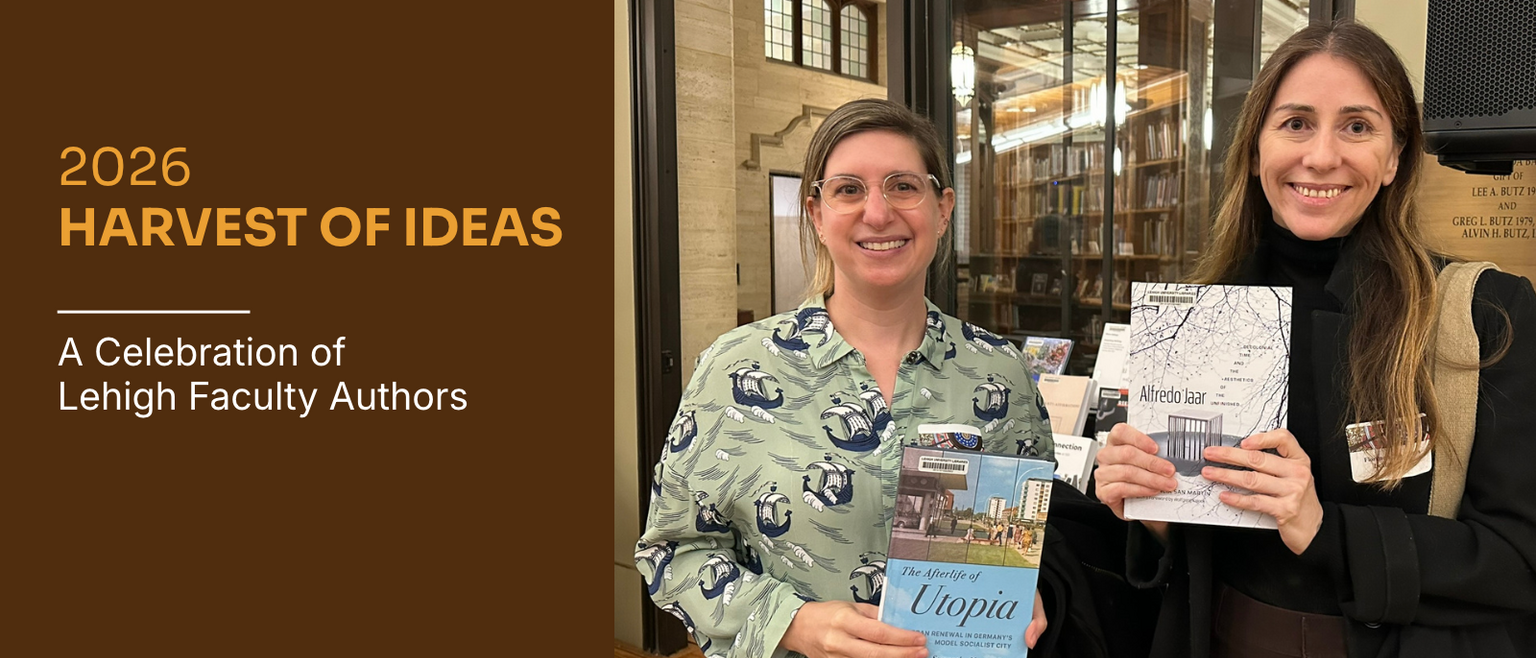
The Friends of the Lehigh University Libraries hosted the 15th annual Harvest of Ideas reception on Monday, November 9, 2026, in the Linderman Library Rotunda, recognizing 18 faculty honorees who published or edited books or musical compositions during the previous year.
Greg Reihman, Vice Provost for Arts & Libraries, welcomed attendees and thanked the Friends of the Libraries for sponsoring the event. University Librarian Boaz Nadav Manes and Bill George, Chair of the Friends of Lehigh University Library Programming Committee, followed with reflections on the significance of authorship, scholarship, and access to knowledge.
In his remarks, Nadav Manes considered what it means to celebrate authorship at a time when “the very nature of knowledge creation is changing so dramatically.” As artificial intelligence becomes increasingly capable of producing what resembles scholarship, he raised a fundamental question: “What does it mean to be an author?” He emphasized that asking meaningful questions, evaluating evidence, and exercising intellectual judgment remain profoundly human. Every work recognized at Harvest of Ideas, he noted, reflects “curiosity, persistence, intellectual courage” — qualities that endure even as the technologies of knowledge creation may change.
He also described research libraries as part of “a much larger public good,” helping ensure that knowledge remains a shared resource rather than a commercial product controlled and shared by a privileged few. He spoke about the importance of supporting open knowledge, reducing barriers to discovery, preserving scholarship, and fostering collaborations that extend the impact of research beyond campus. Some of the most transformative discoveries, he observed, emerge from the freedom to explore ideas without knowing where they might lead. “That freedom is worth protecting,” he said.
Nadav Manes concluded his remarks by reading the names of the faculty honorees and the titles of their 24 scholarly and creative works, spanning books, edited volumes, literary works, and musical recordings.
George, a Lehigh alumnus and co-founder of Bethlehem’s Touchstone Theatre, expressed admiration for the years of research, writing, revision, and determination behind the works being honored. Drawing on his own experience in theater, he acknowledged the demands of the creative process and described Harvest of Ideas as an opportunity to recognize the achievements of faculty authors and their contributions to intellectual life at Lehigh and beyond.
Turning to the Friends' role in supporting the libraries, George highlighted the organization's diverse programming, which brings speakers and conversations on a wide range of topics to campus. “We connect to people. We build community,” he said, emphasizing that the Friends support not just collections, but the experiences and intellectual exchange that libraries make possible. He also extended an invitation to anyone who cares about books, ideas, and the importance of libraries to become involved in the Friends' work.
The Libraries preserve and showcase Lehigh faculty scholarship through the Faculty Authors collection, with copies of faculty-authored books added to Special Collections and noted in the library catalog. The books are also on display in the Linderman Library reading room.
About the Friends
The Friends of the Lehigh University Libraries support engaging library programs, activities, and services to advance the excellence of Lehigh Libraries. To become a member or learn more, visit Joining the Friends.
Faculty honored and their works included:
- Victoria Bergstrom, Inventing Writing: Prophets, Shamans, and the Transmission of Ritual Discourse in North American Indigenous Cultures, 1600–1900
- Matthew Bush, Los otros americanos
- Huai-Dong Cao and Shing-Tung Yau, Surveys in Differential Geometry (Vol. 28): Current Developments in Mathematics and Physics
- Frank E. Curtis and Daniel P. Robinson, Practical Nonconvex Nonsmooth Optimization
- Maryann DiEdwardo, Approaches to Resistance Literature through Phenomenology, Hermeneutics, and Metacognition; Fantastic Worlds
- Samantha Fox, The Afterlife of Utopia: Urban Renewal in Germany’s Model Socialist City
- Edward Gallagher, Our Mollies: heroes or hell-hounds?
- John Hughes, Zen Anti-Affirmations; What the Will Cannot Reach; The Improver
- Bilal Khan, Beyond the Oracle: Prompt Engineering and the Architecture of AI Conversation
- Jessica Levy, Black Power, Inc.: Corporate America and the Rise of Multinational Empowerment Politics
- D/annie Liontas, Sex With a Brain Injury; Let Me Explain You; A Manner of Being
- Barbara Malt, Birds of the Lehigh Valley and Vicinity 3rd edition
- Colleen O’Brien, Reel
- Norrin M. Ripsman, Bullet Holes
- Paul Salerni, Haunted (and other works by Paul Salerni and Dana Gioia); The Life and Love of Joe Coogan
- Florencia San Martín, Alfredo Jaar: Decolonial Time and the Aesthetics of the Unfinished
- Wandi Wang, 沈津乐道:八十忆往录 (Shum Chun’s Delightful Discourse: Eight Decades of Cherished Memories)
- Mark Wonsidler (editor), Creativity and Connection: Lehigh University Art Galleries at 100, with essays by William B. Crow, Joseph J. Helble, and Keidra Daniels-Navaroli