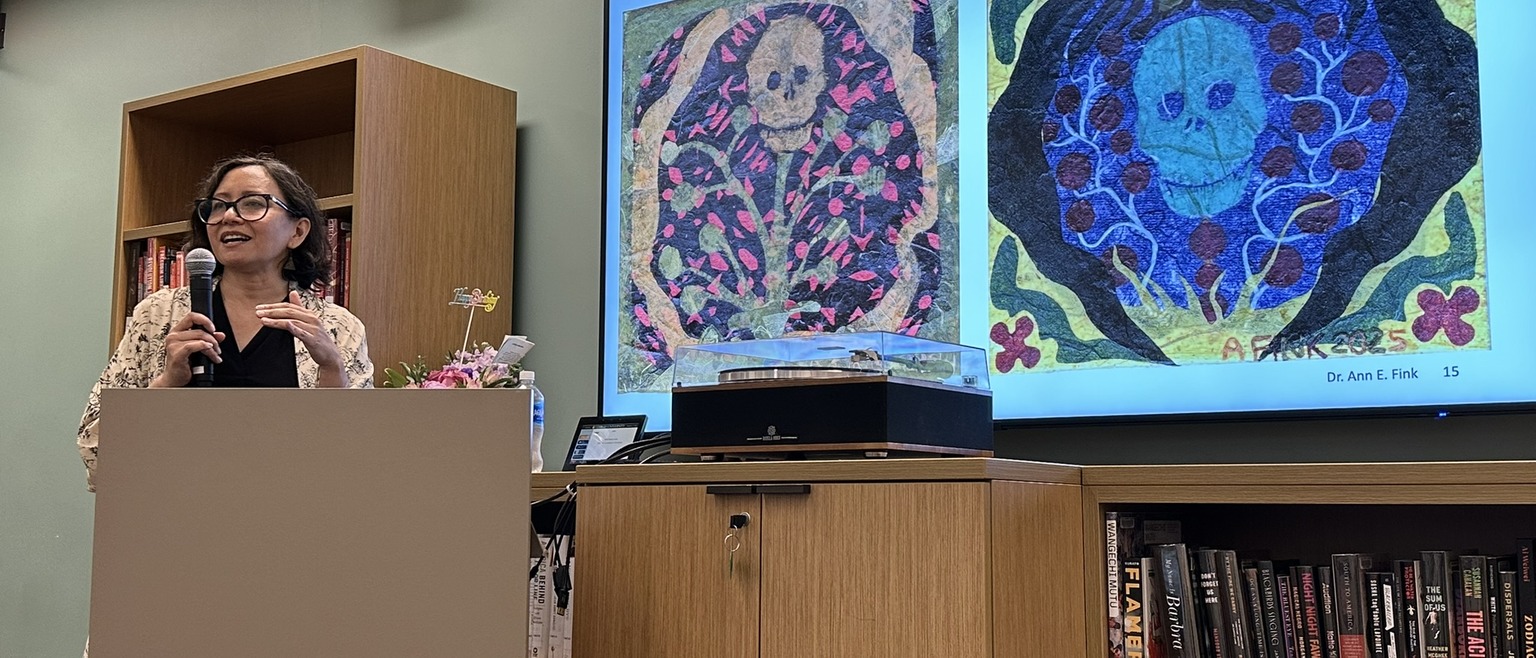
Artist, neuroscientist, therapist, educator, and ethicist Dr. Ann E. Fink visited Lehigh Sept. 17 to reflect on a lifelong practice of using art to observe the world, make sense of it, and tell stories about the people and places within it.
Fink’s talk, Visual Storytelling as a Way of Life, was presented by the Friends of the Lehigh University Libraries in conjunction with their exhibition, Study to Story: Graphic Narrative from Life, on view in Fairchild-Martindale Library.
Fink, who previously taught full time in Lehigh’s Department of Biological Sciences and currently teaches in the College of Education, described the talk as a journey through the many ways art has appeared across their life and work.
At the center of that journey was the idea that creating art can be a way of paying attention.
“I think the stories that we tell about the world and each other matter,” Fink said. “The art that we create about the world and each other matters. Creating art is one method of observation and understanding, and the process of doing that matters.”
Drawing to understand
That process has followed Fink across disciplines. While studying neuroscience, they drew neuroanatomy to understand how the brain worked and later incorporated visual illustration into scientific work. Outside the laboratory and classroom, they drew people, landscapes, plants, movement, and places, continually using observation as a way of learning.
Drawing people repeatedly, Fink said, teaches an artist to notice gesture, emotion, movement, and behavior.
“You learn about people, and you learn to draw people by doing it over and over again, hundreds or thousands of times,” they said.
For Fink, the principle extends beyond figure drawing.
“If you want to understand things, it really pays off to draw them,” they said, adding that other creative practices can serve a similar purpose. Understanding comes through observing, engaging, and returning to something again and again.
That repeated looking is evident throughout Study to Story, which brings together work created across more than 15 years. During the talk, Fink showed different interpretations of the same subjects and invited the audience to notice changes in composition, mood, detail, and perspective.
“Sustained attention matters and repeated observation matters,” Fink said.
The audience’s observations became part of the demonstration, prompting questions about weather, time, mood, memory, and how both artist and subject can change between one rendering and another.
From looking to making
The ideas Fink discussed during the talk carried into two hands-on workshops the following day in Fairchild-Martindale Library. The first was held with students in Collections and Productions: How do libraries, museums, and theaters shape our lives?, a Big Questions Seminar taught by Dr. Greg Reihman, Vice Provost for Arts & Libraries. Later that afternoon, Fink led a well-attended Comics and Creations Workshop open to the Lehigh community.
Across both sessions, participants put ideas from Fink’s talk into practice through drawing, observation, and visual storytelling. Working with color, line, shape, and sketching, participants experimented with ways of seeing and making, including how visual forms can help tell stories about bodies, health, illness, and human experience. The workshops offered an opportunity to slow down, create by hand, and engage directly with the kinds of attentive looking and storytelling at the heart of Study to Story.
Making room for imperfect art
During Thursday’s talk, Fink also deliberately showed work they described as messy, tentative, or unfinished, including childhood drawings, notebook sketches, and early attempts at figure drawing.
“Bad drawings matter a lot,” they said.
Those imperfect works, Fink argued, matter not only because practice develops skill, but because sketches themselves become records of attention, growth, place, and time.
“One thing about drawing is that it does tell you about your life,” Fink said. “It tells you about the development of your artwork, and it really tells you about what you’re tuning into and what you’re paying attention to.”
That willingness to move beyond judgments of “good” and “bad” art, they suggested, can open the door to experimentation and deeper observation.
Attention, silence, and making space
Audience questions extended the conversation into how Fink carries those practices of observation and storytelling into teaching, clinical work, and everyday life. University Librarian Boaz Nadav Manes asked about the patience required to create space for people to reflect and respond, particularly around difficult or personal subjects, noting that Lehigh Libraries also seek to cultivate that kind of individual and communal patience in its spaces. Fink emphasized becoming comfortable with silence and allowing people time to respond, particularly when conversations involve trauma, health, or other emotionally charged topics.
“When you’re comfortable with silence, you help other people get comfortable with silence,” Fink said. “There are a lot of people who are going to need extra time to speak up, to want to share, and you're making space for just a wider range of people, and you're making it okay to do that.”
Fink also connected that kind of attention to everyday creative practice, noting how difficult it can be to resist phones, notifications, and competing demands long enough to stay with something.
“It’s a choice, and it’s a very difficult choice,” they said. “You have to make the time.”
That emphasis on attention also informs Fink’s growing interest in tactile, hand-constructed work. They showed recent cut-paper pieces and described the physical act of building them as particularly meaningful.
“I think analog art actually matters a lot right now,” Fink said. “There is something really important about making things with your hands, about creating art that’s actually tangible, that can be engaged with directly through the senses.”
From observation to story
The final portion of the talk brought those years of observation into Fink’s work in comics and Graphic Medicine, where art, science, ethics, health, and storytelling converge.
Fink showed published comics addressing trauma, gender and health, grief, psychiatry, sexuality, and social justice. Comics, they said, can create space for ethically and emotionally complex questions that are difficult to communicate through words alone.
For Fink, visual storytelling is not neutral.
“Art is not politically neutral or value free,” Fink said. “Science isn’t value free. It’s value laden.”
Fink illustrated that idea through a visual essay on global priorities in neuroethics, posing questions about who gets to participate in science, whose brains are studied or surveilled, how resources are distributed, and which borders and boundaries are treated as meaningful. Comics, they said, can provide a way to ask ethically and emotionally complex questions about science, health, illness, and society.
Asked how the exhibition itself came together, Fink described Study to Story as a way of making visible the relationship between years of close observation and the stories that eventually emerge from it.
“All of those little acts and those moments of observation and appreciation really add up to being able to tell deep and important stories,” they said.
The exhibition traces that progression through figure studies, landscapes, nature studies, experiments in different media, and published comics, allowing visitors to see how individual acts of attention accumulate into a visual language for storytelling.
Study to Story: Graphic Narrative from Life remains on view throughout the 6th floor south study spaces of Fairchild-Martindale Library through spring semester 2027. The exhibition and related programming are sponsored by the Friends of the Lehigh University Libraries.